Wednesday, 3 June 2015

How To Complete Your First Obstacle


Over the past few years obstacle races such as Tough Mudder, The Dirty Dozen and the Spartan race to name a few have become the latest and biggest craze in the world of fitness. I am sure like mine only a couple of weeks ago your Facebook feed was full of pictures, videos and posts about Tough Mudder. If you have been inspired to enter next year or have an obstacle course event coming up soon what is the best way to train for it? 

Here are my top tips on what to include in your training.

1. Build dynamic leg power and strength.

A familiar challenge to many assault courses are high wall style obstacles, which demand you to push and power yourself off the ground to get the necessary climbing momentum. To help train your legs this way include:

  • Jump Squats: stand with your feet a bit wider than hip width apart, drop into a cat position and then quickly explode into the air for maximum height. Land in the squat position and repeat.
  • Alternating Leg Squat Jumps: from a lunge position crouch and then jump upwards, switching your leg position mid air. Land and explode into another repeat. Do 4 sets of 10. when that gets too easy increase.
  • Calf Raises: stand with your toes and balls of feet on it and your arches and heels by extending your ankles as high as possible. lower the heels by bending your ankles until your calves are stretched. Do 4 sets of 10. Make sure you rest the calves thoroughly before you go running.
  • Lunges: stand with your hands on your hips. Take a large step into a lunge with one leg. Both knees should be at a 90 degree angle. Return to the original standing position and repeat leading with the other leg. This is great for building up strength in your quads, hamstrings and glutes. If you have access to weights you can increase the load by holding dumbbells at arms length or a loaded barbell across the shoulders.
2. Fartlek

When training for an obstacle course event, make sure you build up enough endurance strength to complete the full distance. The best training technique to improve your fitness and enable you to run quicker is fartlek. (Which means speed play in Swedish).

Complete a warm up for 10 minutes and begin a succession of efforts varying in length. It doesn't need to be an exact science - some might be a minute, others two minutes one might be for four minutes - all with rest in-between. It might be that you use lampposts to walk and lamppost, jog a lamppost, sprint a lamppost. You may run to the top of the hill. Make sure that the rest in between is a very easy jog/walk of a minute or two and then go on to your next effort.

3. Upper Body Exercises

Obstacle courses make demands on your upper body strength too. Strengthen your back, shoulders, arms and chest will come in very useful when you are scaling large walls or clambering up ropes. If you have access to weights and a gym focus on doing shoulder press, lat pull downs, bicep curls and bench press. For endurance perform sets of 15 reps and for power lift in sets of 3-6reps. In either case go close to max effort twice a week.

4. Gym Free Body Work

If you can't get to the gym then no worries as you will be lifting and pulling your own body weight around then get practising by doing press ups in a wide shoulder width position and also a narrow position on a regular basis.

Pull ups. Yes they are hard but your be doing a lot of this and they are great for working out your arms, back and shoulders.

Tricep dips. Try and work up to 4 sets of 20 reps off a chair. Once you can do this try raising your feet off the ground to make them slightly more challenging.

5. Core Strength

Be sure to work your core strength when training for a course of crazy climbs, ramps, mud pools and drops. A strong core is vital for maintaining a great running posture and so many injuries are caused by being weak in this area.

Exercises like crunches, oblique twists, reverse crunches, front and side planks will help to build your core. There are hundreds of exercises that you can use to keep this part of your training fresh and interesting every training session.

6. Agility
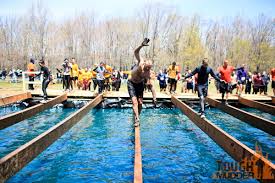
With a course full of obstacles, agility training will make your performance slicker. It will also reduce the risk of injury or being thrown off the course through failure to deal with its demands.

You can add agility exercises into one of your easy runs, by finding a step placing one foot on it then swap over feet as fast as you can for 30 seconds. This will train quick feet and ankle stability to help combat uneven surface. Also find a low log and stand astride it, then jump onto it placing both feet on top. Pause then drop down and repeat for 30 secs. You'll test your balance as well as develop leg power here.

7. Mind Games

Training won't just prepare you physically, but it will also give you the mental confidence to know that you're as prepared as you possibly could be. When on the course try and focus on the immediate task you come across. Before you know it you will have tackled that obstacle, take 10 seconds to reflect and congratulate yourself and then move on to the next one.

Remember the courses are design to be tough and challenging but at the end of the day the are mostly designed to be fun, so enjoy yourself.

I hope this helps and thank you for reading.

Pete

Saturday, 28 March 2015

Keep It Simple Weight Loss!

I get asked all the time what is the best and quickest way to loose weight? Unfortunately there is no one thing which has the miracle answer to weight loss. Instead it is about having an all round balanced diet and getting regular exercise.

In this blog I look at some top simple tips on helping you achieve these without feeling like you are missing out.

Dietary Advice

1. When dishing up a meal or snacking eat 10% less than you normally would eat.

2. Try to think first and if there is a better choice make that one.

3. Try to avoid foods with more than 5g per 100g of sugar in.

4. Try to avoid buying anything marked 'LOW FAT'. I know this sounds strange, but usually when something is low in fat it is high in sugar or something else that is bad for us.

This naturally rules out chocolate and other really sweat things that if we are honest with ourselves we all know that they aren't that good for us.

Exercise

Wherever possible try and swap your transport for working. I can't stress enough how important walking is. It is a really good foundation for your mind and body.

It teaches your body to burn fat and be more efficient, prepares your body for exercise, it is free, you can do it anywhere and you don't need special equipment to do it.

Try and get at least 3 hours a week of doing some kind of whole body exercise, that will incorporate increasing your heart rate as well as bodyweight or resistance exercises such as squats, lunges, press ups etc.

Finally I would like you to remember that being healthy or the weight you want to be and living a happy healthy life doesn't restrict you from eating certain foods, having another chocolate bar, going down the pub with your friends for a pint, or eating out at a restaurant.

Changing is easy if you make small manageable changes.

Remember.....

1. Crash diets or diets full stop don't work.
2. You can eat food and a lot of the right food and still be healthy.
3. Fat doesn't make you fat SUGAR does.
4. Exercise can be fun so find something you enjoy and get out there.
5. Walking is good.

Move a little bit more and make better choices, then good things will happen.

Thanks for reading

Pete

Wednesday, 4 March 2015

Have You Done It Outside Yet?

Do you find going to the gym a struggle and tedious? Your not alone, many people struggle with boredom and a lack of motivation when going to the gym doing the same exercises, day after day, in an uncomfortable, sometime no air conditioning and windowless gym.

This is why the majority of my PT clients and bootcamp classes are taken outside. We live in a great place to make use of local parks, fields, Forests, hills, beaches and transforming them into your gym space, meaning every training session can be different. All you need is a bit of imagination.

What are the benefits of training outside?

  1. Fresh air makes for a better experience: All you gym users will know that sometimes the air that you breathe feels unpleasant. Contrast this with outdoor training, where in most cases the air will feel fresher and more pleasant.
  2. Training outside has health benefits: Training outside isn't just a lot of fun, it's good for your health too. It increases extra exposure to the sunlight that supplies the body with vitamin D. Study's have also shown that it burns more calories and produces higher levels of post-exercise endorphins.
  3. You can do it anywhere and at anytime: You can't have the excuse that you don't have the time to get to exercise, incorporate it in your everyday life. Walking or riding your bike to work, taking a walk and getting some fresh air at lunchtime, walking the dog etc. 
  4. Get Gardening: Fed up with running and cycling? Swap your trainers for wellies instead - you could find that you shed pounds just as easy. 
  5. It adds some variety and fun: when you initially think about exercising outside you think about going for a run or bike ride, which is great but don't forget exercise can be anything that gets your heart rate elevated, so why not try a game of frisbee in the park or beach, tree climbing, swimming in the sea, or just some bodyweight training but outside.
  6. Your more likely to stick with it: If you enjoy doing something then you are more likely to adhere to it and therefore more likely to see the results that you want.
As I said at the top the options are endless when it comes to exercising outside. All you need is a bit of imagination and anything is possible. 


So with Spring just round the corner why not get outside and experience the amazing place that we live on the Isle of Wight and make exercise fun and enjoyable.

If you would like to start exercising outside in a fun and friendly environment then why not give PB Fitness - Bootcamps a go? To book your place or for more information then just  >>>>CLICK HERE<<<.

Many thanks for reading

Pete

Friday, 27 February 2015

Are You A Sports Massage Devotee?


If you are a sports massage devotee then you might be interested in the new offering that I have for block bookings.

A bit like training, the more regularly you have a sports massage the more likely it is that the effects will hold and the more likely you are to reap the benefits.

Most people wait until they're in proper pain before they book a massage, without realising that preventative treatment is actually more cost effective (and a lot less painful) in the long run.

So at PB Fitness I am offering:

  • 4x 60 minute massages for £120 usually £140
I Probably don't need to tell you how beneficial massage is, but here's a few main benefits:

  • Increases flexibility
  • It reduces pain
  • It increases joint range of motion
  • It helps you burn fat - (the better you move the more calories you'll burn during exercise and the less likely you are to get injured, which will stop you exercising)
  • It feels fantastic
  • Its stress relieving
  • And many more

Get in touch today to book your treatment.

Many thanks for reading

Pete

Monday, 16 February 2015

No Pain No Gain?....Go Hard or Go Home?


We have all heard the phases 'no pain no gain' and 'go hard or go home' banded around, and to be honest these have to be my least favourite quotes within the fitness industry.

When I hear the word pain it doesn't encourage me to do that activity if it's going to cause me pain. If you are new to exercise or overweight, then nothing is more likely to put you off exercise than pain.

Pain isn't there for no reason. It is there to indicate that there's something wrong.

I not talking about a bit of a 'burn' after doing 20 press ups, 20 squats, 20 sit ups etc. I mean that 'OW, thats about to snap / feels unnaturally tight / feels like I'm being stabbed,' type pain. All of which indicate an actual problem and that you should stop.

We all know what happens if we don't stop, we get injured and then you don't get to do any exercise at all and have to spend ages getting better, which will probably kill your motivation and lead you to eat more.

So...don't ignore pain pain. Lactic acid and muscle soreness is fine, sharp stabbing pain is not!

At PB Fitness I don't believe in eliciting pain; in fact I consider breaking people with inappropriate exercises to be dumb training. Nor do I believe in making people struggle to get results that they want.

Because just like you, I want you to enjoy feeling fit and working out!

I want you to have a laugh whilst exercising!

I want you to enjoy your food and find it easier to stay in shape!

Whilst 'go hard or go home' is helpful for some, if you train by beasting yourself in to the ground every time then this is a fast track way to burning out, getting injured, getting sick or giving up!

You need to be smarter when you train and leave a bit left in the tank. This way you will be able to get some more great work done tomorrow, instead of not being able to walk down the stairs or sit down without screaming in pain!

January and February are primetime for overtraining with people starting their new year resolution and going to hard to soon, wanting to see instant results and this is one of the biggest reasons why most resolutions end prematurely.  However, unfortunately it takes time to build up a programme affectively.

Don't let your fitness journey end this way. Train smart, train hard and leave a little bit in the tank, ready to kick butt the next day.
At PB Fitness I will do absolutely everything we can to make sure that the experience my clients have is as enjoyable as possible. This is both from a training and nutritional perspective. If it is a programme that you need then check out my Personal Training Packages

As well as this I now offer soft tissue massage that will help you stay on top of any niggles you might have >>>CLICK HERE<<< for more information.

Many thanks for reading

Pete

Wednesday, 11 February 2015

Scale Rage


I'am not a huge fan of weighing people and using this information as the be-all and end-all to see if their programme is working correctly. The basis behind weighing is to provide you with positive or negative feedback as to how well you're doing, whether you are trying to lose weight or maintain the weight you are at.

Many people believe that weighing is automatically beneficial and that whatever the result of the weighing, it will in some way encourage adherence to whatever program the person is on. However in my experience, more often than not this is not the case and people become slaves to the scale and get what I like to call scale rage.

In addition to this having a reliance on the scales shifts the focus of exercise from the desired outcomes of health, well-being, confidence, improved body shape and fitness, to just a number on the scales.

The other major problem is that weighing will inevitably leed to comparisons with the so call social 'norms', most of which are not that normal.

This is why at PB Fitness I focus on monitoring body fat %, as well as using circumference measurements and regular reviews of health biomarkers, fitness levels and mood. I have found these measurements to be far more accurate representations of progress and a lot less disheartening for my clients.

If you would like to try this out then sign up for personal training session which includes a free fitness consultation, 1, 4, 8 or 12 personal training sessions and nutritional advice.

Many thanks for reading

Pete

Thursday, 15 January 2015

Post Natal Exercise

Just as in my last post about exercise during pregnancy, then post natal exercise is just as important and their should be clear aims for post natal exercise, which includes:

  • Re-tone pelvic floor to reduce the risk of stress incontinence.
  • Re-tone abdominal muscles to increase strength and enable them to support the spine and regain figure.
  • Develop good technique in basic daily tasks, essential in back care.
  • Correct/regain good posture.
  • Enhance self confidence.
  • Weight loss. Please be advise that this is a more of a long term aim and should not be a major consideration during the immediate post natal period.

1. It is not recommended that you return to sport or exercise classes before the six week post natal check up following normal delivery. If you have experienced delivery by caesarian section you should delay this further to approximately 8-12 weeks. In the mean time you should take your baby for a daily walk and aim to increase the pace and length of walk gradually over the 6-8 week period. You should pay attention to your posture and the height of the pram handle.

2. Whilst in hospital you may find that you are given a few post natal exercises for the abdominal muscles and the pelvic floor. For the pelvic floor you should do the same as you did during pregnancy of fast and slow contractions of the muscles that stop you going to wee. For your abdominal muscles you should perform static contracts, which involves pulling the tummy in holding and then releasing and this should've done as much and as often as possible.
 
3. You should avoid doing sit ups until your abdominal muscles are strong enough to remain flat during the exercise, otherwise Doming will occur. Doming of the abdominal muscles is the term used to describe the bunching or bridging up of the abdominal muscles during a sit up.

4. I know this is the most important thing to most woman, however weight loss should be gradually decreased. A gentle but progressive programme of aerobic exercise will help, however breast-feeding places many demands on the body and requires slightly greater fat deposits than you may be accustomed to, so it is important that you do not go for a dramatic or total weight loss until breast-feeding has finished. You should look at regaining your pre-pregnancy weight after 3-12 months.

If you would like more information about pre and postnatal exercise then please get in contact or CLICK HERE as I am a fully qualified ante and postnatal instructor who can adapt your training programme to your new needs.